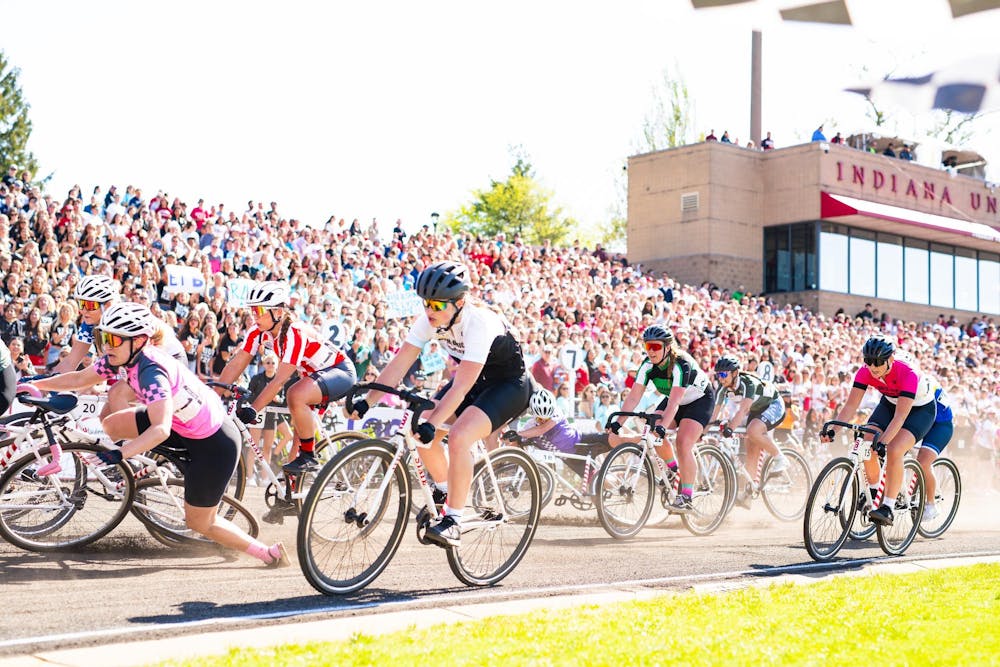
Alright, for the non-Hoosiers and non-bike nerds in the room, let's do a quick primer on what the Little Five is, how it works, how to win it, why it kicks ass, and why you should watch the women's race tomorrow at 4:00 ET/3:00 GTZ and the men's on Saturday at 2:00 ET/1:00 GTZ.
[A small caveat to all of the analysis below: I was a not particularly fast or fit cyclist on the Illinois team, which really was a semi-mobile beer drinking squad.]
What are we talking about?
The Little 500 is famously the World's Greatest College Weekend. Bloomington becomes a total shitshow. There are parties, there are drunk students falling asleep on lawns, there are concerts and shows and all kinds of festivities to mark the end of the semester. But the reason for the season? It's a collegiate bike race unlike any other.
Why should I care?
Because it's a lasting remnant of the best parts of college sports. Because it's kids racing for honor, for glory, for teammates and friends and roommates and because it's fun as hell to go full send on a rapidly disintegrating cinder track made of kitty litter in front of 20,000 drunk and screaming Hoosiers. Because it's the most relatable thing ever. Because it's at the core of our Midwestern upbringing. It's nice outside; Let's play bikes with our friends.
When did it start?
The Little 500 (the men's edition, technically) is marking its 75th edition this weekend! In 1919, an Indiana native named Howard “Howdy” Wilcox won the Indianapolis 500 car race. He tragically died in a car crash a few years later, but his son, Howard Wilcox, Jr., would later attend Indiana University in the 1940s. After he graduated, Wilcox, Jr. took over as the director of Indiana University Foundation and looked for ways to raise funds for the organization. Wilcox came across some students running a bike race around Hickory Hall and found his inspiration. The Little 500 was born in 1951 as a combination of that impromptu campus bike race and his Wilcox's father's legacy on the Brickyard in 1919. Doesn't get more Indiana than that.
Who gets to race?
So there are 33 teams for the men's and women's races. Traditionally, the race was contended by dorm halls and Greek life squads, but anyone can compete. The frats and sororities have been the most frequent historical winners, but there are plenty of non-Greek wins in recent years. Most famous would be the Cutters team, was pays homage to the Best Goddamn Cycling Movie of All Time aka the 1979 Academy Award winner Breaking Away. The Cutters won in 1984 and then 14 more times since. On the women's side, the race has been going on since 1988 and has been generally dominated by Kappa Alpha Theta (last year's repeat winner) and Kappa Kappa Gamma. But there are tons of indie groups competing these days with all sorts of backgrounds. Qualification happens a few weeks before the race; only the top 33 teams get to make it to the big day.
Ok, cool. Hit me with the rules.
Every team has four riders on their Little 500 squad. No professionals, no varsity-level club cyclists, no illegal recruiting. 200 laps on the quarter-mile track for the men, 100 for the women. Every team has one rider going at a time, and each team must do a minimum number of exchanges in which one rider replaces the other. This can be a chaotic and dangerous moment because of crashes and also occasionally banging sensitive parts onto aluminum bike frames.
Bikes are standardized and provided by State Bicycle Company. No alterations are allowed. The bikes have a single gear, and only coaster brakes (where you pedal backwards to slow down, like a kid’s bike) are permitted.
So what's the strategy here?
What a good looking question! Let's break the race down into sections.
The Start: All of the riders are arranged in the start grid by virtue of their qualification time. The front is better, because you don’t want to be caught out, whether from a crash or a breakaway. The first two laps are neutralized, which means you can’t move out of your start grid spot. After the photographer’s lap and a warm-up lap, the pace car will pick up speed. Once the green flag waves, the riders are off!
The Race: Bike races, even ones on a cinder velodrome, are all about aerodynamics, saving energy, and avoiding crashes. Drafting behind riders costs less energy to maintain the same speed as the rider in front of you. If you’ve never ridden in the middle of a pack of bikes before, it’s truly magical. It feels as if you’re getting dragged forward without any real effort required. But if you’re stuck in the center of the pack, you’re boxed in and less able to respond to moves and crashes.
If you’ve ever crashed at the center of a pack of bikes, it’s the sound of metal on appendages, shattering carbon, bent steel, whirring chains. Crashing sucks, but it produces the the constant strategic debate: take the energy savings and sit in the back, or lead the race and expend the effort? In a short race like this, it’s a better bet to hit the front, and you’ll see every team in contention try to push the pace and stay at the head of the pack.
The Burn: This is where things get weird. Every team has to do a certain number of exchanges (10 for men, 5 for women), and the exchanges have to happen at each team’s designated pit spot on the side of the velodrome. But if you do an exchange while riding in the pack, someone’s getting run over or you’re getting dropped and left behind. So you’ll see riders pull a Burn, where they sprint as hard as possible, get a gap, slam on the coaster brakes to slow down as rapidly as they can while skidding into the pit, and then exchange the bike in one smooth motion. This allows the new rider to get to speed and jump on the back of the churning peloton.
The Handoff: And here’s the other side of the Burn. Like we mentioned above, some handoffs are good, some are not, and sometimes you slam sensitive body parts onto the top tube in the process. Remember, these bikes are single speeds, so no shifting is possible. To get up to speed, the new cyclist has to get a running start, jump onto the pedals, and hammer the sole gear to get moving, all without crashing. If the exchange is botched or a rider crashes, then they have to expend even more energy trying to catch the raging pack. The peloton waits for no one.
The Breakaway: Sometimes it’s a Burn, sometimes it’s a Breakaway. Teams will have specialists for certain scenarios: either sprinters with raw finishing speed, endurance skills for soaking up laps, or time-limited but massive time trial ability. The time trial specialists will drop their heads, hammer it as hard as they can, and try to pull away from the pack for good. If you see a rider lap the field, they’re going to be tough to catch. As the race continues, the also-rans get lapped repeatedly and the contenders keep pushing the pace higher and higher to prevent anyone else from breaking away and catching back up. Nothing in life is better than breaking away from the pack and holding the gap.
The Finish: Chaos. At the 190th lap, the race directors pull the stragglers off of the velodrome to avoid unnecessary carnage and crashes. But when the white flag is raised to indicate a single lap remaining, all bets are off. This is where you hope you have your best rider, your fastest sprinter, the biggest rider in your team out on the bike. This is where pure wattage counts. And if you can take the lead and hold on until the checkered flag flies, yours is the glory in front of 20,000 screaming and heavily inebriated fans.
And for those that don’t win? Well, probably some vomiting and mud and cinder chunks in that gash on their knee. Maybe a broken tooth or road rash on their butt or a ripped jersey. But its glory for them too, because the 20,000 drunken Hoosiers cheer for everyone at the Little Five.